Join WhatsApp Channel
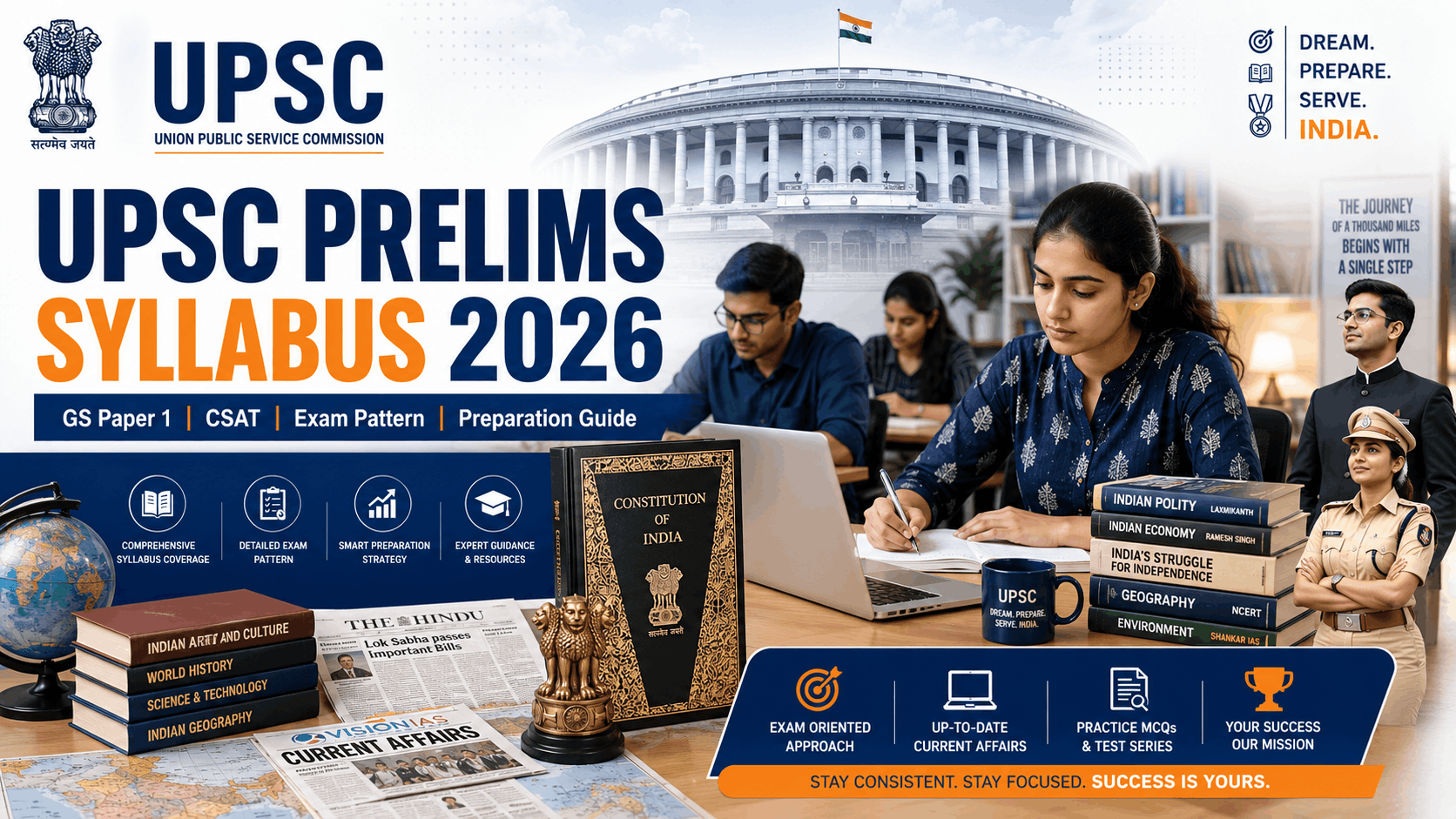
The Civil Services Examination conducted by the Union Public Service Commission is considered one of the most prestigious and competitive examinations in India. Through this examination, candidates are selected for top services such as the Indian Administrative Service, Indian Police Service, Indian Foreign Service, and several other Central Government services. so here is UPSC Prelims Syllabus 2026
Every year, lakhs of candidates apply for the UPSC Civil Services Examination, but only a small percentage successfully qualify. One of the primary reasons for failure is preparing without a clear understanding of the syllabus.
The UPSC Prelims Syllabus 2026 serves as the foundation for the entire Civil Services Examination. Candidates who thoroughly understand the syllabus can create an efficient study plan and avoid wasting time on irrelevant topics.
This guide provides the latest UPSC Prelims Exam Pattern, complete GS Paper 1 Syllabus, CSAT Syllabus, preparation strategy, recommended books, and frequently asked questions.
UPSC Civil Services Prelims 2026 Overview
| Particular | Details |
|---|---|
| Exam Name | Civil Services Examination (CSE) |
| Conducting Authority | UPSC |
| Exam Level | National |
| Examination Mode | Offline |
| Selection Process | Prelims, Mains, Interview |
| Frequency | Once Every Year |
| Official Website | upsc.gov.in |
UPSC Prelims Exam Pattern 2026 and UPSC CSAT Syllabus
The Preliminary Examination consists of two objective papers.
| Paper | Subject | Marks |
|---|---|---|
| Paper 1 | General Studies | 200 |
| Paper 2 | CSAT | 200 |
Important Points
- Both papers are objective type.
- Negative marking is applicable.
- CSAT is qualifying in nature.
- General Studies Paper 1 determines qualification for Mains.
UPSC Prelims Marking Scheme
| Particular | Details |
|---|---|
| Correct Answer | Full Marks |
| Wrong Answer | One-Third Negative Marking |
| Unattempted Question | No Penalty |
| CSAT Qualifying Marks | 33% |
UPSC General Studies Paper 1 Syllabus 2026
General Studies Paper 1 is the most important paper in the Preliminary Examination because its marks determine whether a candidate qualifies for the Mains Examination.
Current Events
Questions are regularly asked from recent developments.
Important Areas
- National Events
- International Affairs
- Government Schemes
- Economy Updates
- Science Developments
- Reports and Indexes
- International Organizations
Indian History and National Movement
History forms a major portion of the examination.
Topics
- Ancient India
- Medieval India
- Modern India
- Freedom Struggle
- Important Movements
- Constitutional Developments
High Priority Areas
| Topic | Importance |
|---|---|
| Modern History | Very High |
| Freedom Movement | Very High |
| Ancient History | Medium |
| Medieval History | Medium |
Indian Polity and Governance
Polity is one of the highest-scoring sections.
Topics
- Constitution
- Fundamental Rights
- Directive Principles
- Parliament
- Judiciary
- President
- Prime Minister
- Constitutional Bodies
- Election Commission
- Local Governance
Indian and World Geography
Physical Geography
- Earth Structure
- Climate
- Volcanoes
- Earthquakes
- Oceanography
Indian Geography
- Rivers
- Agriculture
- Minerals
- Industries
- Transport
World Geography
- Continents
- Climate Zones
- Important Locations
Economic and Social Development
Important Topics
- Indian Economy
- Inflation
- Banking
- Budget
- Fiscal Policy
- Monetary Policy
- Poverty
- Employment
- Sustainable Development
Environment and Ecology
Environment has become increasingly important in recent UPSC examinations.
Topics
- Biodiversity
- Wildlife Conservation
- Climate Change
- Environmental Conventions
- Protected Areas
- Pollution
- Ecosystems
General Science
Areas Covered
- Physics
- Chemistry
- Biology
- Biotechnology
- Space Technology
- Scientific Developments
UPSC CSAT Syllabus 2026
The Civil Services Aptitude Test (CSAT) evaluates a candidate’s analytical and comprehension abilities.
Comprehension
- Reading Passages
- Interpretation
- Analytical Questions
Logical Reasoning
- Analytical Reasoning
- Logical Deduction
- Decision Making
Quantitative Aptitude
- Percentage
- Ratio
- Average
- Profit and Loss
- Time and Work
- Time and Distance
Data Interpretation
- Graphs
- Charts
- Tables
- Statistical Analysis
Best Books for UPSC Preparation
📚 Best UPSC & Government Exam Books
Explore expert-recommended books for UPSC Prelims, Mains, SSC, Railway, Banking and State PSC examinations.
View Recommended Books →Check Your Age Eligibility
🧮 UPSC Age Calculator
Calculate your exact age and determine eligibility for UPSC and other government examinations.
Check Age Eligibility →Photo & Signature Resizer Tool
📷 Need UPSC Application Photos?
Resize photographs and signatures according to government recruitment requirements using our free tool.
Open Free Tool →UPSC Prelims 2026 Preparation Strategy
Phase 1: Foundation Building
Duration: First 3 Months
Focus on:
- NCERT Books
- Basic Polity
- Geography Fundamentals
- Economy Basics
- History Foundation
Phase 2: Advanced Preparation
Duration: Next 3 Months
Focus on:
- Standard Reference Books
- Current Affairs Integration
- Topic-Wise Mock Tests
- Revision Notes
Phase 3: Prelims-Oriented Revision
Duration: Last 2–3 Months
Focus on:
- Mock Tests
- Previous Year Questions
- Current Affairs Revision
- Weak Area Improvement
Common Mistakes UPSC Aspirants Make
| Mistake | Impact |
|---|---|
| Ignoring Current Affairs | Lower Score |
| Skipping Revision | Poor Retention |
| Studying Too Many Sources | Confusion |
| Avoiding Mock Tests | Low Accuracy |
| Neglecting CSAT | Risk of Disqualification |
Why Understanding the UPSC Syllabus Matters
Most successful candidates begin preparation by understanding the official syllabus. The syllabus acts as a roadmap and helps candidates:
- Avoid unnecessary study material.
- Prioritize important topics.
- Improve revision efficiency.
- Build a structured preparation plan.
- Increase chances of qualifying for Mains.
Frequently Asked Questions (FAQ)
Is UPSC Prelims tougher than SSC and Railway exams?
Yes. UPSC Prelims generally requires a much broader understanding of subjects and current affairs compared to most other competitive examinations.
Is CSAT qualifying in UPSC?
Yes. Candidates must secure at least 33% marks in CSAT.
Which subject is most important in UPSC Prelims?
Current Affairs, Polity, Environment, Economy, and Modern History generally carry significant weightage.
How many hours should I study daily for UPSC?
The quality of study matters more than hours. Consistent preparation with proper revision is essential.
Can a beginner start UPSC preparation without coaching?
Yes. Many successful candidates prepare through self-study using standard books and regular practice.
Official Source & Important Disclaimer
Official Information: Candidates should verify all details from the official notification and official recruitment website before applying online.
Disclaimer: JobApplyIndia.in is an informational platform and is not associated with any government department, recruitment board, or official authority.
We do not provide job placement services, form-filling services, or collect any application fee from candidates.
Candidate Safety Notice: Never pay money to any third party for government job selection or recruitment assistance.