Join WhatsApp Channel
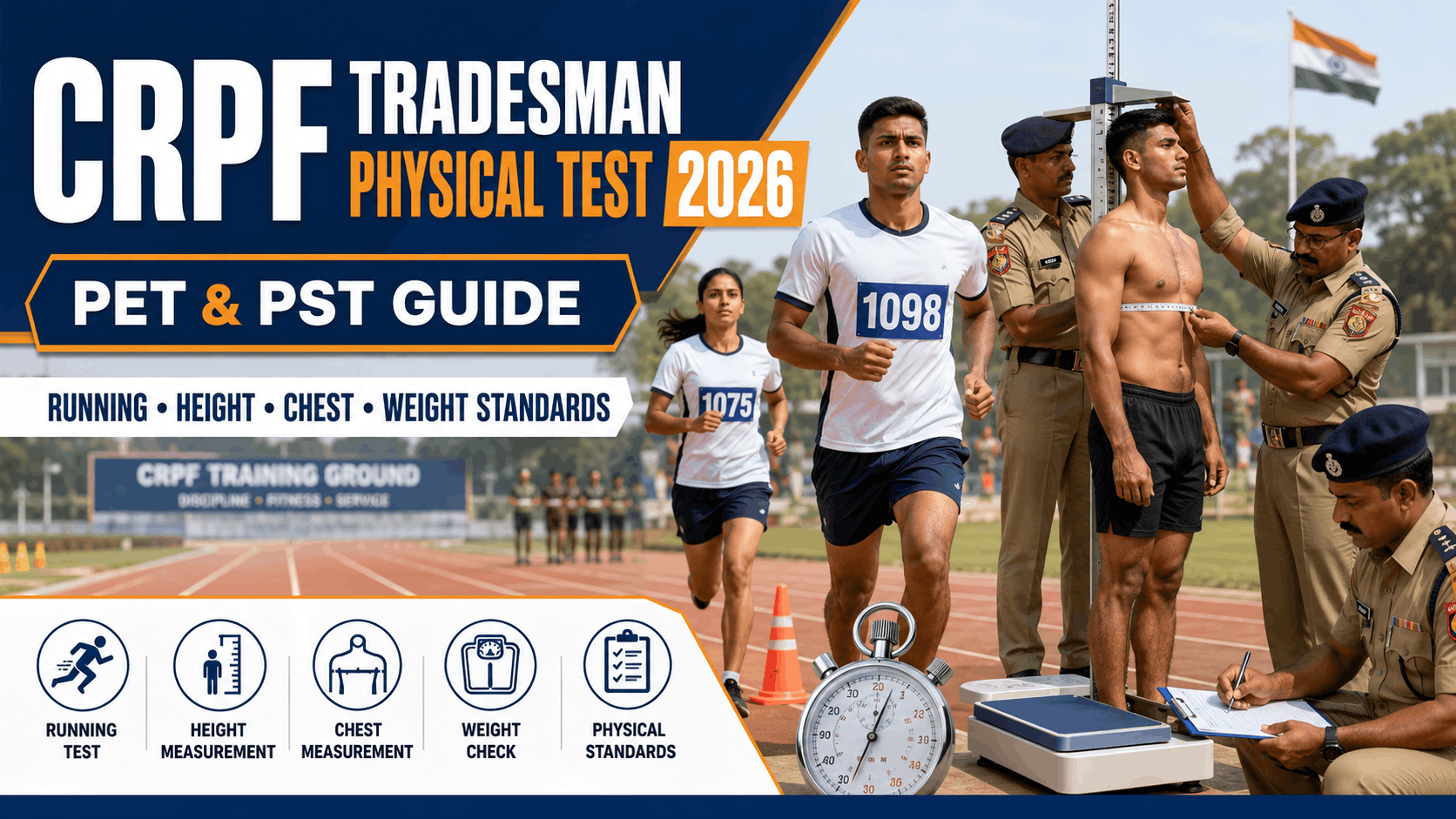
CRPF Tradesman Physical Test (PET/PST) 2026 Getting selected as a CRPF Constable Tradesman is not only about passing the written examination. Every candidate must also qualify the Physical Efficiency Test (PET) and Physical Standard Test (PST). These tests check whether a candidate is physically fit to perform duties in the Central Reserve Police Force.
Many candidates prepare only for the written exam and ignore physical fitness. As a result, they fail during the PET/PST stage. If you understand the complete physical requirements in advance, you can prepare properly and improve your chances of selection.
In this article, you will learn everything about the CRPF Tradesman Physical Test 2026, including running time, height, chest measurement, weight standards, preparation tips, important rules, documents required, and common reasons for disqualification. All information is based on the latest CRPF recruitment notification and official recruitment portal.
CRPF Tradesman PET/PST 2026 Highlights
| Particular | Details |
|---|---|
| Recruitment Authority | Central Reserve Police Force (CRPF) |
| Post Name | Constable (Technical & Tradesmen) |
| Physical Test | PET & PST |
| PET Type | Qualifying Only |
| PST Type | Height, Chest & Weight Measurement |
| Written Exam | CBT |
| Official Website | CRPF WEBSITE |
What is CRPF PET?
PET (Physical Efficiency Test) checks the physical endurance of candidates.
In this stage, candidates have to complete the prescribed running event within the given time limit.
The PET is only Qualifying in nature.
- No marks are awarded.
- No ranking is prepared.
- Candidates only need to qualify.
If a candidate fails the PET, he or she cannot appear in the next stage of recruitment.
What is CRPF PST?
PST (Physical Standard Test) is conducted after biometric verification.
During PST, officials measure the candidate’s:
- Height
- Chest (Male candidates only)
- Weight
Candidates must satisfy the prescribed physical standards mentioned in the official notification.
CRPF Tradesman Selection Process
The recruitment process generally consists of the following stages:
- Biometric Verification
- Physical Efficiency Test (PET)
- Physical Standard Test (PST)
- Computer Based Test (CBT)
- Trade Test / Skill Test
- Document Verification
- Detailed Medical Examination (DME)
- Final Merit List
Candidates must qualify each stage to move to the next stage.
CRPF Tradesman Physical Efficiency Test (PET)
The PET mainly consists of a running event.
For Male Candidates
| Event | Requirement |
|---|---|
| Race | 1600 metres |
| Time | Within 7 Minutes |
For Female Candidates
| Event | Requirement |
|---|---|
| Race | 800 metres |
| Time | Within 5 Minutes |
Candidates who complete the race within the prescribed time are declared qualified.
There are no additional marks for finishing earlier than the prescribed time.
Is PET Qualifying or Merit Based?
Many candidates ask this question.
The answer is PET is only Qualifying.
Whether you complete the race in:
- 5 minutes
- 6 minutes
- 6 minutes 50 seconds
the result will remain Qualified, provided you finish within the official time limit.
Therefore, your focus should be on completing the race comfortably instead of trying to finish first.
What Happens During PET?
On the PET day, candidates generally follow these steps:
- Report at the examination centre.
- Identity verification.
- Biometric verification.
- PET instructions by officials.
- Running event.
- PET result declaration.
- Qualified candidates proceed for PST.
Candidates should carefully follow all instructions given by CRPF officials during the physical test.
Important Rules During PET
Candidates should remember the following points:
- Reach the centre before reporting time.
- Wear comfortable sports shoes.
- Carry your admit card.
- Carry a valid photo ID.
- Follow officials’ instructions.
- Do not use unfair means.
- Complete the race within the prescribed time.
- Stay hydrated before the test.
- Avoid heavy meals immediately before the race.
Tips to Qualify the Running Test
Many candidates fail because they start running too fast.
Instead, follow this simple strategy.
Week 1
- Run 1 kilometre daily.
- Walk for 10 minutes after running.
Week 2
- Increase running distance to 1.5 kilometres.
Week 3
- Complete 1600 metres comfortably.
- Practice timing.
Week 4
- Practice exactly according to PET standards.
- Run wearing sports shoes similar to those you will use during the examination.
Also include:
- Stretching
- Squats
- Lunges
- Push-ups
- Core exercises
- Deep breathing
These exercises improve stamina and reduce the risk of injury.
Common Mistakes Candidates Make
Avoid these mistakes during preparation:
- Starting too fast
- Not practising daily
- Wearing new shoes on exam day
- Not sleeping properly before PET
- Skipping warm-up
- Eating heavy food before the race
- Ignoring hydration
Small mistakes often become the reason for failure.