
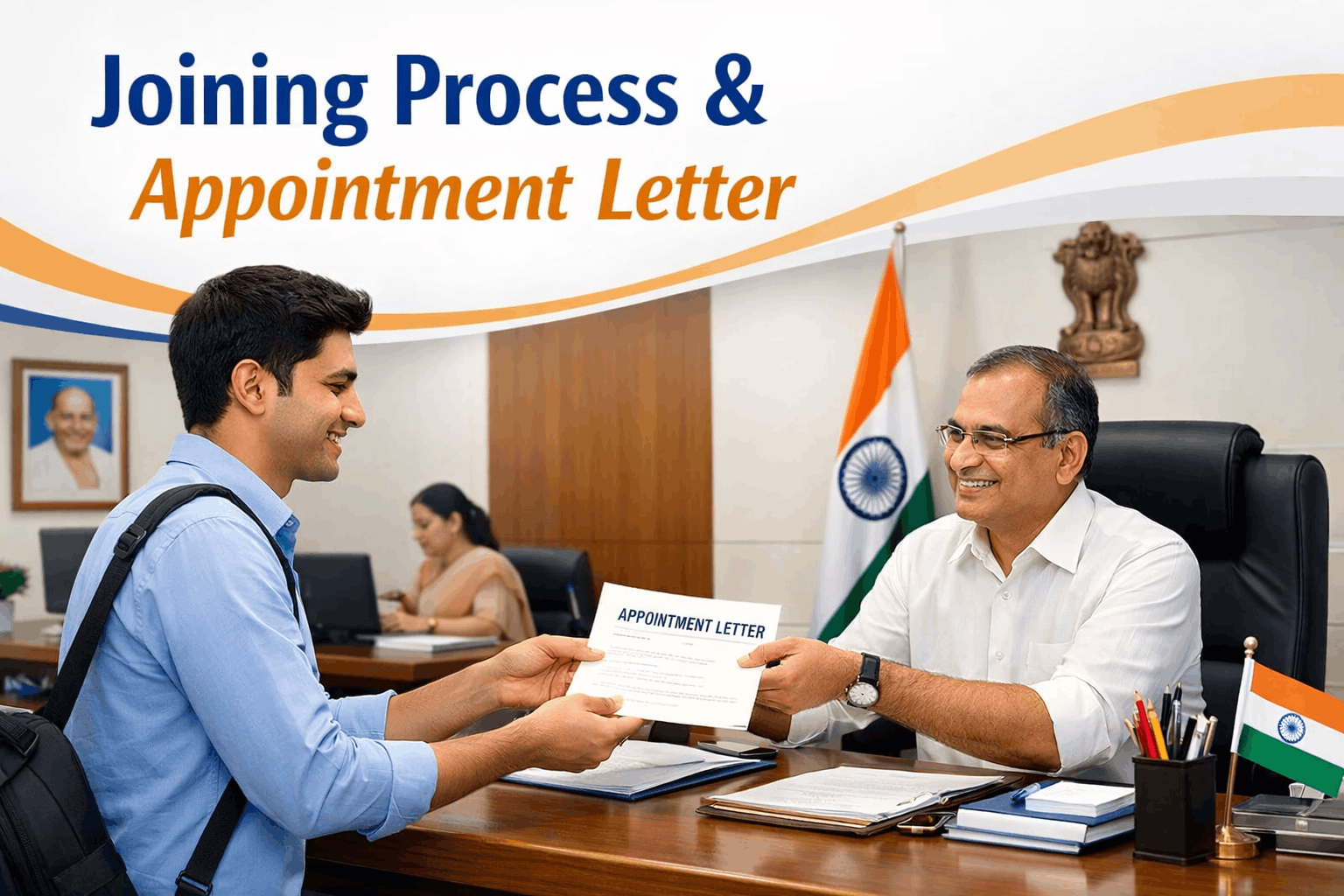
After clearing all stages of selection, receiving the appointment letter is the most awaited moment for government job aspirants. However, many candidates are unsure about the government job joining process & appointment letter timelines, and formalities after selection.
This guide explains the complete process—from appointment letter issuance to final joining—along with required documents and practical tips.
What Is an Appointment Letter?
An appointment letter is an official document issued by the recruiting authority confirming a candidate’s selection for a government post. It includes :-
- Post name and department
- Place of posting
- Joining date and reporting instructions
- Pay level and service conditions
This letter legally authorizes a candidate to join the service.
When Is the Appointment Letter Issued?
The appointment letter is usually issued :-
- After document verification
- After medical examination (if applicable)
- After final merit list approval
The time gap may range from 2 weeks to several months, depending on the department.
Mode of Appointment Letter Delivery
Appointment letters may be sent via :-
- Official email
- Online recruitment portal login
- Speed post (in some departments)
Candidates must regularly check official emails and portals.
Joining Process Step-by-Step
Step 1: Read the Appointment Letter Carefully
Candidates should carefully read :-
- Joining date & reporting time
- Location details
- Required documents
- Instructions for extension (if any)
Step 2: Arrange Required Documents
government job joining process 2026 Commonly required documents include :-
- Appointment letter copy
- Identity proof (Aadhaar/PAN)
- Educational certificates (original + copies)
- Medical fitness certificate
- Character certificate
- Passport-size photographs
- Bank account details
Step 3: Reporting at the Joining Office
On the given date, candidates must report to :-
- Department office
- Training institute
- Allotted posting location
Late reporting may result in cancellation.
Step 4: Verification & Joining Formalities
At the office:
- Documents are verified
- Service bond (if any) is signed
- Joining report is submitted
After completion, the candidate is officially onboarded.
Step 5: Training / Probation Period
Many government jobs include :-
- Mandatory training
- Probation period (1–2 years)
During this time, performance and conduct are assessed.
What Is a Joining Report?
A joining report is a written confirmation submitted by the candidate stating :-
- Acceptance of appointment
- Date of joining
- Willingness to serve
It becomes part of the employee’s service record.
Can Joining Date Be Extended?
Some departments allow:
- Extension due to medical or personal reasons
- Written request with valid proof
However, extension is not guaranteed and depends on authority approval.
Common Mistakes to Avoid
- Missing the joining deadline
- Not carrying original documents
- Ignoring appointment letter instructions
- Providing incorrect bank or personal details
Such mistakes can delay or cancel joining.
FAQs
Q1. Is appointment letter the final confirmation?
Yes, it confirms selection, subject to joining formalities.
Q2. Can posting location be changed?
Usually no, except under special departmental rules.
Q3. Is training compulsory?
Yes, if mentioned in the appointment letter.
| Authority | Website |
|---|---|
| Staff Selection Commission (SSC) | https://ssc.nic.in |
| Union Public Service Commission (UPSC) | https://www.upsc.gov.in |
| Indian Railways Recruitment | https://indianrailways.gov.in |
Conclusion
The government job joining process is straightforward but requires careful attention to instructions and timelines. Candidates should prepare documents in advance, follow official guidelines, and complete joining formalities responsibly to begin their service smoothly.
read related Article
- Government Job Selection Process in India – Complete Step-by-Step Guide
- Latest Government Jobs in India – Apply Online, Eligibility & Updates
- Government Job Documents Verification Process – Complete Guide
- Medical Test for Government Jobs – Complete Guide (2026)
- Government Job Eligibility Criteria in India – Age Limit, Qualification, Reservation & Relaxation Rules (Complete Guide 2026)
Pingback: Government Job Bond Rules: Service Bond, Penalty & Exit (2026)
Pingback: Name DOB Mismatch in Government Jobs – Rules & Correction Process (2026)
Pingback: Wrong Documents Submitted in Government Job – Rules & Fix (2026)
Pingback: Government Job Promotion Rules in India Eligibility & Process
Pingback: Government Job Resignation Rules & NOC Process (2026)