
Join WhatsApp Channel
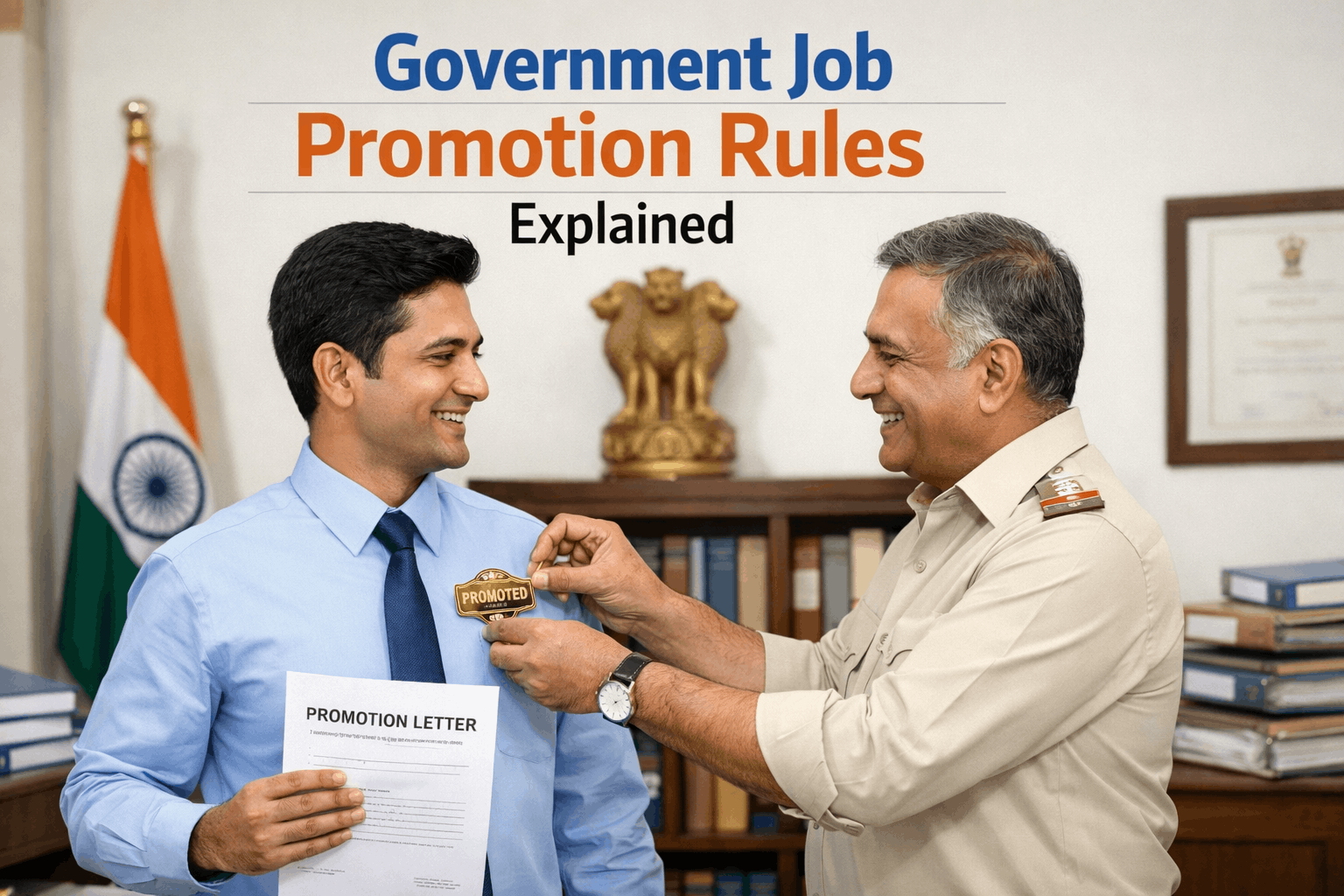
Promotion in a government job is governed by service rules, not personal discretion. Every promotion follows a defined process based on eligibility, seniority, performance records, and departmental vacancy position.
This guide explains the complete government job promotion system in India, including eligibility criteria, Departmental Promotion Committee (DPC), time-bound promotions, and common doubts.
What Is Promotion in Government Jobs?
A promotion is the advancement of a government employee to:
- A higher post
- Higher pay level
- Greater responsibility
Promotion does not happen automatically and is regulated by:
- Recruitment Rules (RRs)
- Departmental Promotion Committee (DPC)
- Vigilance and service records
Government Job Promotion Hierarchy (General)
Typical Career Progression Example
| Entry Level | Next Level | Higher Level |
|---|---|---|
| Group C Post | Group B Post | Group A Post |
| Assistant | Section Officer | Under Secretary |
| Constable | Head Constable | Sub-Inspector |
Exact hierarchy varies by department.
Eligibility Criteria for Promotion
To be eligible for promotion, an employee must:
- Complete minimum years of service
- Be confirmed (probation completed)
- Have satisfactory Annual Performance Appraisal Reports (APAR)
- Clear departmental exams (if prescribed)
- Have no pending disciplinary/vigilance case
Related guide: Government Job Probation Period Explained
Role of Departmental Promotion Committee (DPC)
The DPC is the authority that decides promotions.
DPC Considers:
- Seniority list
- APAR ratings (last 5 years generally)
- Vigilance clearance
- Vacancy position
DPC recommendations are binding once approved.
Types of Promotion in Government Jobs
1️⃣ Seniority-Based Promotion
- Based mainly on years of service
- Common in clerical and non-technical posts
2️⃣ Merit-Based Promotion
- Based on performance and exams
- Common in technical and officer cadres
3️⃣ Seniority-Cum-Merit Promotion
- Combination of both
- Most common system in government services
Time-Bound Promotion / MACP Scheme
Many government employees get promotions under time-bound schemes.
MACP (Modified Assured Career Progression)
- Applicable when regular promotion is delayed
- Provides financial upgradation, not post change
| MACP Level | Service Period |
|---|---|
| 1st MACP | 10 years |
| 2nd MACP | 20 years |
| 3rd MACP | 30 years |
MACP ensures salary growth even without vacancy-based promotion.
Promotion During Probation – Is It Allowed?
No.
Promotion is not allowed during probation.
An employee must first be confirmed in service.
Related guide: Government Job Probation Period Explained
Promotion and Reservation Rules
Promotion may include:
- Reservation for SC/ST candidates
- Department-specific reservation policies
Reservation in promotion applies only where notified by government orders.
Impact of Disciplinary or Vigilance Case
- Pending inquiry → promotion kept in sealed cover
- Cleared later → promotion may be given retrospectively
Clean service record is essential.
Can Promotion Be Refused?
Yes.
An employee may:
- Refuse promotion temporarily
- Lose seniority advantage
Repeated refusal can impact future promotions.
Common Reasons for Promotion Delay
- Non-availability of vacancies
- Poor APAR ratings
- Pending disciplinary case
- Failure in departmental exam
FAQs – Government Job Promotion Rules
Q1. Is promotion guaranteed in government jobs?
No. Promotion depends on eligibility, vacancy, and performance.
Q2. Does MACP change designation?
No. It provides financial upgradation only.
Q3. Can promotion be challenged legally?
Yes, if rules or procedures are violated.
Q4. Does resignation affect promotion eligibility?
Yes. Resignation breaks service continuity.
imp. article
- Government Job Joining Process & Appointment Letter
- Government Job Bond Rules – Service Bond & Exit
- Explore all Government Job Guides
DoPT (Department of Personnel & Training) – Promotion & Service Rules
- As per DoPT service rules… DOPT WEBSITE




Jar ekhadya varshi badhatikarita tumhi tappytappyane 3prakarchya yadit samavishta hou shakat asal tar tinimadhe basu shakat asel tar eil tashi badhai gheta eil ka