
Join WhatsApp Channel
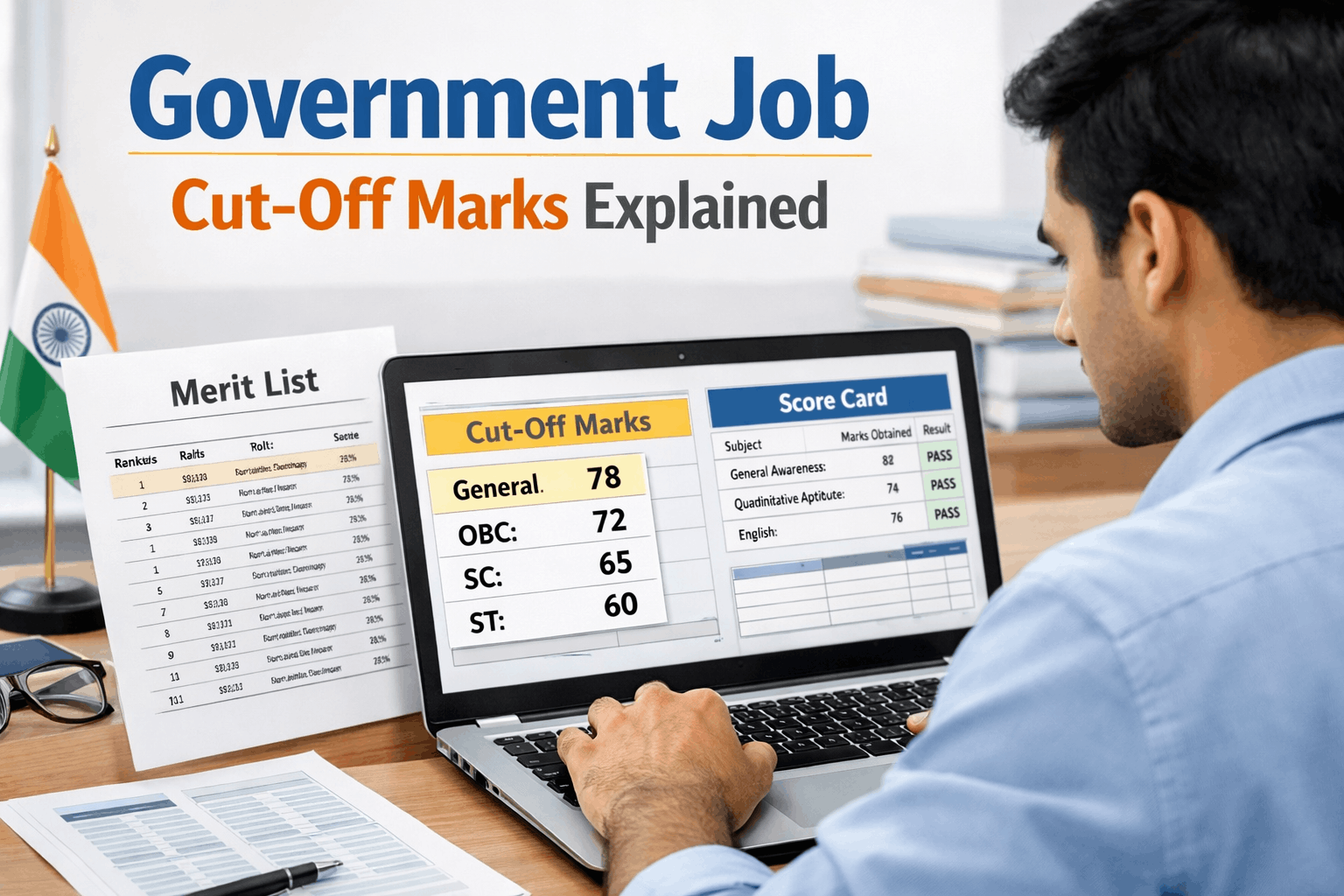
Cut-off marks play a crucial role in every government job selection process. Thousands of candidates clear written exams, but only those who meet the official cut-off proceed to the next stage. Understanding how cut-off marks are calculated helps candidates plan better and avoid unrealistic expectations.
This guide explains the government job cut-off system in India, including normalization, category-wise cut-off, and how final selection is affected.
What Are government job cut off marks?
government job cut off marks are the minimum qualifying marks required to advance to the next stage of recruitment, such as:
- Mains examination
- Skill test
- Interview
- Medical examination
Cut-off marks are decided after the exam, not before.
Key Factors That Decide Cut-Off Marks
1. Number of Vacancies
Higher vacancies generally result in lower cut-off marks, while limited vacancies increase competition and raise the cut-off.
2. Number of Candidates Appearing
When more candidates appear for an exam, competition rises, leading to a higher cut-off.
3. Difficulty Level of the Exam
- Easy paper → Higher cut-off
- Difficult paper → Lower cut-off
4. Category-Wise Reservation
government job cut off marks differ for:
- General (UR)
- OBC
- SC
- ST
- EWS
Each category has a separate qualifying threshold.
What Is Normalization in Government Exams?
Normalization is used when exams are conducted in multiple shifts. Since difficulty levels vary across shifts, raw marks are adjusted using a standardized formula to ensure fairness.
Raw marks are not final marks. Normalized marks decide cut-off and merit.
SSC Normalization
SSC (Staff Selection Commission) exams jaise SSC CGL, CHSL, MTS me multiple shifts hoti hain. Har shift ka difficulty level alag ho sakta hai. Isi fairness ko maintain karne ke liye SSC normalization method use karta hai.
SSC Normalization ka Purpose:
- Different shifts ke difficulty level ko balance karna
- Fair comparison karna
- Candidate ko disadvantage na ho agar uski shift tough thi
SSC Normalization Kaise Kaam Karta Hai?
SSC statistical formula use karta hai jisme:
- Raw Score
- Shift Average
- Standard Deviation
consider kiye jaate hain.
Agar aapki shift tough thi:
Normalized score raw score se thoda increase ho sakta hai
Agar shift easy thi:
Normalized score thoda decrease bhi ho sakta hai
Final cut-off normalized marks par decide hota hai.
RRB Normalization
RRB (Railway Recruitment Board) exams me normalization bahut important hota hai kyunki Railway exams me lakhs of candidates multiple shifts me exam dete hain.
RRB Normalization Features:
- Exam multiple days aur shifts me hota hai
- Difficulty level vary karta hai
- RRB equi-percentile method use karta hai
RRB Equi-Percentile Method Kya Hai?
Is method me:
- Har shift ke top scorer ko base maana jata hai
- Performance percentile ke base par marks adjust kiye jate hain
Example:
Agar aapki shift me average score kam tha (tough paper),
to normalization ke baad aapka score improve ho sakta hai.
Railway Group D, NTPC, ALP exams me ye commonly apply hota hai.
Banking Normalization
Banking exams (IBPS, SBI PO, SBI Clerk, etc.) me bhi normalization use hota hai.
Banking exams mostly:
- Online CBT mode me
- Multiple shifts me conduct hote hain
Banking Normalization Ka Main Objective:
- Uniform evaluation
- Fair ranking system
- Shift difficulty balance karna
Banking sector me bhi statistical formula use hota hai jo:
- Mean marks
- Standard deviation
- Candidate percentile
ko consider karta hai.
Final merit list normalized score ke basis par banai jati hai.
SSC Normalization – How It Works in SSC Exams
SSC (Staff Selection Commission) conducts exams such as SSC CGL, CHSL, MTS, and others in multiple shifts across different days. Since the difficulty level of each shift may vary, SSC applies a normalization process to ensure fairness in evaluation.
Purpose of SSC Normalization
- To balance differences in difficulty across shifts
- To ensure fair comparison among candidates
- To prevent disadvantage for candidates who appeared in a tougher shift
How SSC Normalization Works
SSC uses a statistical formula that considers:
- Raw Score (marks obtained by the candidate)
- Average marks of the shift
- Standard deviation of marks in the shift
If a candidate appears in a tougher shift:
- The normalized score may increase slightly compared to the raw score.
If the shift was relatively easier:
- The normalized score may decrease slightly.
The final cut-off and merit list are prepared based on normalized scores, not raw marks.
RRB Normalization – Equi-Percentile Method Explained
RRB (Railway Recruitment Board) exams such as RRB NTPC, Group D, and ALP are conducted in multiple shifts due to the large number of applicants. To maintain fairness, RRB uses the equi-percentile normalization method.
Key Features of RRB Normalization
- Exams are conducted over multiple days and shifts
- Difficulty level varies between shifts
- Equi-percentile method is applied to standardize scores
What Is the Equi-Percentile Method?
Under this method:
- The percentile ranking of a candidate in their shift is calculated
- Scores are adjusted based on percentile comparison across all shifts
For example:
If your shift had a lower average score due to higher difficulty, your normalized score may improve after adjustment.
The final merit list is prepared based on normalized marks.
Banking Normalization – Shift-Based Score Adjustment
Banking exams such as IBPS PO, IBPS Clerk, SBI PO, and SBI Clerk are conducted in online CBT mode across multiple shifts. Since the question difficulty can differ between shifts, normalization is applied.
Objectives of Banking Normalization
- To ensure uniform evaluation
- To maintain fairness in ranking
- To balance variations in shift difficulty
Banking normalization typically considers:
- Mean marks of the shift
- Standard deviation
- Candidate percentile
The final score used for merit ranking is the normalized score, not the raw score.
Cut-Off vs Merit List
| Cut-Off Marks | Merit List |
|---|---|
| Minimum qualifying score | Final ranking of selected candidates |
| Category-wise | Rank-wise |
| Stage qualification | Final appointment |
Importance of Previous Year Cut-Off Marks
Previous year cut-offs help candidates:
- Estimate safe scores
- Understand competition trends
- Set realistic preparation targets
However, cut-offs should never be copied blindly, as exam conditions change every year.
Common Myths About Cut-Off Marks
- Cut-off marks are fixed
- Normalization is unfair
- High marks guarantee selection
Selection depends on the entire recruitment process, not just marks.
How to Prepare With Cut-Off in Mind
- Target score = previous cut-off + safety margin
- Focus on accuracy and time management
- Analyze mock test performance
How to Check Official Cut-Off Marks
Cut-off marks are published only on official recruitment websites after results.
Official Sources:
(Always rely on official notifications only.)
Related Guides
- government job joining process & appointment letter
- Government Job Result & Merit List
- Government Job Medical Test in India
- government job joining process & appointment letter
- Best books for government job preparation.
Conclusion
Cut-off marks are a filtering mechanism, not a guarantee of selection. Understanding how they work gives candidates clarity, confidence, and a strategic advantage.




Mera caste wrong hai kaise change kare pls help my caste